Want to buy or sell something? Check the classifieds
  • The Fedora Lounge is supported in part by commission earning affiliate links sitewide. Please support us by using them. You may learn more here.

How many new jackets do you have coming (and how many potential ones)?

Carlos840

I'll Lock Up
Messages
5,138
Location
London
probably dye is something that takes time to get reaction like hair dye or fabric dye, or even tea or coffee dye, while anything that leaves color once the water or alcohol or whatever solution evaporate is pigment? but somewhat labelled dye?

Dyes and pigments are chemically different whatever you do with them.
Dyes are water soluble, pigments are not.
 

jonbuilder

My Mail is Forwarded Here
Messages
3,733
Location
Grass Valley CA Foothills
Wikipedia says aniline leather is simply dyed leather and since all leather is dyed (even "natural" or "tan" as leather without any dye is gray/green (yeah, kinda what you'd expect something dead to look like)). So basically, all leather is aniline.
I am not sure all leather is dyed. The off-white Trojan Night Rider I purchased this year has a top coat of paint. Due to poor storage in humid China, the paint was flaking off. Under the paint, the leather is a grayish-green color. It seemed that thin layers of hide spilt off with the paint coat.
I do not see where a dye was used?

F56342DB-EA6D-4BFC-8074-238C93570D02_1_105_c.jpeg
014CE645-4477-4C43-AAF7-4EE7358E4815_1_105_c.jpeg
 

jonbuilder

My Mail is Forwarded Here
Messages
3,733
Location
Grass Valley CA Foothills
Respectfully disagree. Dave Himel has been studying leather tanning in depth for many years. He has visited multiple different tanneries in Japan, Europe, and the US -- sometimes multiple times -- and interacted extensively and intimately with the tanners. The notion that he is uninformed about the leather he sells and/or no more knowledgeable than the average jacket enthusiast is nonsensical. Dave may not be as knowledgeable as the actual tanners, but he knows exponentially more than most enthusiasts. I have spoken with Dave about this precise issue. His has an impressive command of the intricacies of leather tanning.
Dave Himel is in a league by himself
 

Rich22

Practically Family
Messages
595
Location
G.B.
From left to right:
Full aniline pigment dyed (dyed all the way through + top coat; pigment dyed (top coat only); full aniline (dyed all the way through, no top coat)

View attachment 361577
Is that information from a tannery? The one on the left looks like oil pull leather, or at least waxed and oiled, as opposed to having a layer of lacquer/plastic applied. It isn't uniform enough.
 

Rich22

Practically Family
Messages
595
Location
G.B.
I am not sure all leather is dyed. The off-white Trojan Night Rider I purchased this year has a top coat of paint. Due to poor storage in humid China, the paint was flaking off. Under the paint, the leather is a grayish-green color. It seemed that thin layers of hide spilt off with the paint coat.
I do not see where a dye was used?

View attachment 361819 View attachment 361820
Aaarg! The horrors of painted/coated leather when it flakes off!
 

Rich22

Practically Family
Messages
595
Location
G.B.
Respectfully disagree. Dave Himel has been studying leather tanning in depth for many years. He has visited multiple different tanneries in Japan, Europe, and the US -- sometimes multiple times -- and interacted extensively and intimately with the tanners. The notion that he is uninformed about the leather he sells and/or no more knowledgeable than the average jacket enthusiast is nonsensical. Dave may not be as knowledgeable as the actual tanners, but he knows exponentially more than most enthusiasts. I have spoken with Dave about this precise issue. His has an impressive command of the intricacies of leather tanning.
Let's blame whoever wrote that page on his website then! He needs to fix that. It's a catastrophe of nonsense.
 

ABCD

I'll Lock Up
Messages
7,710
Is that information from a tannery? The one on the left looks like oil pull leather, or at least waxed and oiled, as opposed to having a layer of lacquer/plastic applied. It isn't uniform enough.
The one on the left is Field Leather's 'pony shinki'. Doesn't feel waxy or oily at all. Instead it has a lacquer layer like you call it. It indeed isn't totally uniform, I think the topcoat is semi transparent.
 

Rich22

Practically Family
Messages
595
Location
G.B.
Dyes and pigments are chemically different whatever you do with them.
Dyes are water soluble, pigments are not.
This is how the definition is used correctly, with ink, for example. How it became co-opted to mean 'coated with plastic' when it comes to leather, I have no idea.
 

Rich22

Practically Family
Messages
595
Location
G.B.
The one on the left is Field Leather's 'pony shinki'. Doesn't feel waxy or oily at all. Instead it has a lacquer layer like you call it. It indeed isn't totally uniform, I think the topcoat is semi transparent.
That's interesting- thanks for the reply. It would be fascinating to know what they coated it with.
The main difference is solubility, dyes are soluble, pigments are not.

The term Aniline just defines a chemical composition, aniline dye is a chemical compound that dyes the leather/material itself. That is the important thing to remember, the material itself changes colour. And the dye itself is translucent. Aniline dye leaves no residue.

Pigment is basically paint, it is a pigment (a coloured powder) that is in suspension within a liquid (not disolved).
Once the liquid evaporates it leaves a coat of pigment behind, just like when you repaint your bike or your house.

The main difference is that the pigment leaves a coloured residue behind, the dye doesn't, it has coloured the material itself.
All you have to do to fully get it is buy a pot af anyline dye and try it on a leather, wood, fabric, it reacts very differently from paint.
I own some pigment inks for artistic purposes- unlike traditional dye based inks they are entirely water resistant. Once they are absorbed by paper they are not going anywhere unless you use a knife to scratch away the paper they've been absorbed by. The only dye based ink I have that is water resistant is cellulose reactive. If the 'pigments' applied to leather were like the pigment inks I'm familiar with, I can see no harm or drawback in staining leather with them. If anything, it seems a sensible thing for a tannery to try.
 

Rich22

Practically Family
Messages
595
Location
G.B.
It looks very pretty, I must say. Is that sample yours? How does it react if you scratch it with a fingernail? Thanks.

Edit: If a pigment 'ink' of sorts was applied to absorbent aniline leather it would be absorbed and stain the top layer, and would be there permanently. If it was applied to finished water resistant leather then it would likely sit on top, as it would when applied to glossy photo paper as opposed to absorbent copy paper. Perhaps this is akin to what is done to blackened-brown leather? The pigment 'ink' sits on top until it's rubbed off?
 
Last edited:

ABCD

I'll Lock Up
Messages
7,710
It looks very pretty, I must say. Is that sample yours? How does it react if you scratch it with a fingernail? Thanks.
It's really hard to scratch, even if you use something hard and sharp (thanks to/due to the pigment top coat).

I say due to because that also means it won't develop character as fast as non-pigment dyed leather.
 

Rich22

Practically Family
Messages
595
Location
G.B.
It's really hard to scratch, even if you use something hard and sharp (thanks to/due to the pigment top coat).

I say due to because that also means it won't develop character as fast as non-pigment dyed leather.
Ok, it seems more than a mere pigment ink has been applied in that case. Do you think the top coat contains any additional colouring? If it's a transparent layer I think 'top coat' is infinitely more appropriate than 'pigment'. By the way, I edited the post you replied to, to add some comments.
 

ABCD

I'll Lock Up
Messages
7,710
Ok, it seems more than a mere pigment ink has been applied in that case. Do you think the top coat contains any additional colouring? If it's a transparent layer I think 'top coat' is infinitely more appropriate than 'pigment'.

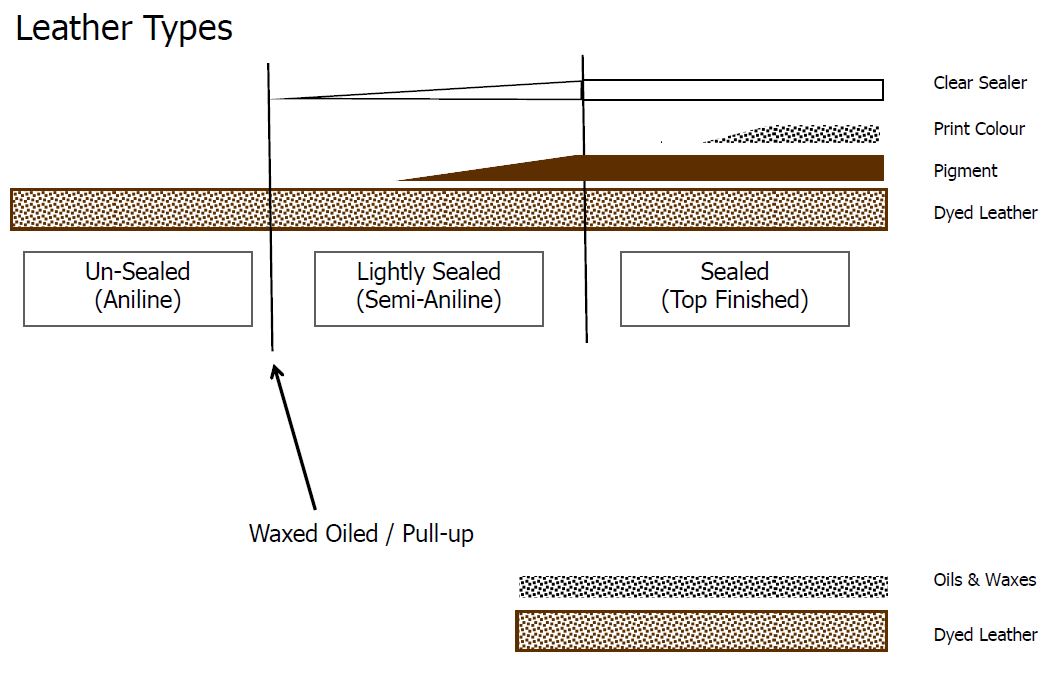
Semi-Aniline: Leather that is aniline dyed and coated with matching pigment and/or other topical finishes to even out the color and add protection. Also called aniline-plus or protected aniline.
 

Rich22

Practically Family
Messages
595
Location
G.B.
It would be considered semi-aniline with just a synthetic sealer applied even without colouring, as it radically changes the characteristics of the leather.

This little diagram I stumbled across is nice, and shows how despite being in its own category, oil pull/waxed/oiled leather would fall somewhere between aniline and semi aniline. I'll take care to ensure all future leather goods I buy fall squarely in this category.

leather-chart.jpg

https://www.paulfordleatherproducts.co.nz/identifying-leather.html
 
Messages
17,496
I am not sure all leather is dyed. The off-white Trojan Night Rider I purchased this year has a top coat of paint. Due to poor storage in humid China, the paint was flaking off. Under the paint, the leather is a grayish-green color. It seemed that thin layers of hide spilt off with the paint coat.
I do not see where a dye was used?

View attachment 361819 View attachment 361820

Not all, of course but most is 'cause it's like I said earlier, leather that hasn't been dyed is exactly the color of your jacket, under the finish It's gray or very lightly blue-ish and not very nice to look at at all - but - It's perfect for bright top coat, such as white. Some would argue that that's the natural color of chrome-excelled tanning and they wouldn't be wrong but not all chrome tanned leather turns out that way as you can add any color to the CX solution.
Vegetable tanned leather is more brown, due to the properties of the tanning solution which tends to be brown-ish but again, some dye is added to it as well as the color wouldn't be nearly as rich and nice as what people expect veg-tanned hide is.

But all that is just one more thing that adds to the confusion; For instance, acrylic top coat vs. dyed surface. Clearly not the same thing, not by a long shot, but by just going with terms such as aniline or whatever, the differentiation gets blurred even further which, to me, is a much more substantial than whether a piece of hide's been covered with dye or soaked in it.

Any leather that has any kind of color already has pigment applied to the surface by default and since all brown leather is dyed (to some extent), physical properties of leather that's surface dyed vs. the kind dyed all the way thru are negligible. Functionality wise, it's the same thing.

However, heavy, leather with acrylic finish applied to it is completely different than the other sort. That's the kind of leather that's considerably more waterproof and indeed intended for riding. Like your Trojan.

In short, dye don't make no top coat. Dyed surface is simply that - Dyed leather. Top coat or actual finish if you will, is another thing.
 
Messages
17,496
Respectfully disagree. Dave Himel has been studying leather tanning in depth for many years. He has visited multiple different tanneries in Japan, Europe, and the US -- sometimes multiple times -- and interacted extensively and intimately with the tanners. The notion that he is uninformed about the leather he sells and/or no more knowledgeable than the average jacket enthusiast is nonsensical. Dave may not be as knowledgeable as the actual tanners, but he knows exponentially more than most enthusiasts. I have spoken with Dave about this precise issue. His has an impressive command of the intricacies of leather tanning.

I didn't mean Dave himself but the info that's on the website doesn't really say very much about any of the leather they use that's of any particular use to the consumer. There's a lot written down but all that we can essentially learn is that all of their leathers is 1.2 to 1.3 mm, pigmented, waxy & that they smell like mimosa. And they're tanned in Japan. Or Italy. But that's okay. I believe that even that's going into excessive detail that isn't really necessary for any of us.

Except then they go on about something they termed Full grain suede which couldn't possibly make any less sense!
Sanded leather by definition has no grain! It's been sanded off. It's gone! That's the whole point of sanding. I don't know how Dave allowed for that to sit on his page for so long but it ultimately doesn't matter as the average consumer won't have a clue what any of it really means and they'll still get a top quality suede (as opposed to split hide or maybe even rough-out).
 

jonbuilder

My Mail is Forwarded Here
Messages
3,733
Location
Grass Valley CA Foothills
Not all, of course but most is 'cause it's like I said earlier, leather that hasn't been dyed is exactly the color of your jacket, under the finish It's gray or very lightly blue-ish and not very nice to look at at all - but - It's perfect for bright top coat, such as white. Some would argue that that's the natural color of chrome-excelled tanning and they wouldn't be wrong but not all chrome tanned leather turns out that way as you can add any color to the CX solution.
Vegetable tanned leather is more brown, due to the properties of the tanning solution which tends to be brown-ish but again, some dye is added to it as well as the color wouldn't be nearly as rich and nice as what people expect veg-tanned hide is.

But all that is just one more thing that adds to the confusion; For instance, acrylic top coat vs. dyed surface. Clearly not the same thing, not by a long shot, but by just going with terms such as aniline or whatever, the differentiation gets blurred even further which, to me, is a much more substantial than whether a piece of hide's been covered with dye or soaked in it.

Any leather that has any kind of color already has pigment applied to the surface by default and since all brown leather is dyed (to some extent), physical properties of leather that's surface dyed vs. the kind dyed all the way thru are negligible. Functionality wise, it's the same thing.

However, heavy, leather with acrylic finish applied to it is completely different than the other sort. That's the kind of leather that's considerably more waterproof and indeed intended for riding. Like your Trojan.

In short, dye don't make no top coat. Dyed surface is simply that - Dyed leather. Top coat or actual finish if you will, is another thing.
Thank you for explaining monior. I now understand some of the various processes for preparing a hide o to be made into a jacket better. I do agree with you, a lot of us put too much emphasis on the preparation of the leather and would be better-served concentrationing of the jacket design and construction.
 

Forum statistics

Threads
114,743
Messages
3,181,397
Members
58,581
Latest member
MDz
Top