Want to buy or sell something? Check the classifieds
  • The Fedora Lounge is supported in part by commission earning affiliate links sitewide. Please support us by using them. You may learn more here.

Berets, Anyone?

Daan

Vendor
Messages
971
Location
Wellington, Aotearoa
“the latter” means the Txapeldun uses lighter weight material than the Super Lujo, correct?

Thank you for the wealth of beret info!

can you also confirm that the material desity per sq meter of the material, also changes when going to diameters above 12.5”?

My 12.5" Elosegui weighs about 4oz while my 14.5" weighs about 7oz.. not sure how much of that difference is due to the diameter difference, as distinguished from a change in material density.

View attachment 720494

fwiw, Im in the habit of soaking my new berets in Hot water and then wearing them wet, until they dry on my head. The hot water shrinks them by about 2" in diameter, and makes them less floppy.
The Txapeldunak are different berets from the Exposición Super Lujo, not just in diameter. The Super Lujo is the densest and heaviest beret due to its thread and tight knit, whereas the Txapeldunak are the same density as the Exposición Tupida (Tupida can be translated as “thick” or “dense”), but lighter than the Super Lujo models.
 

ADK

New in Town
Messages
15
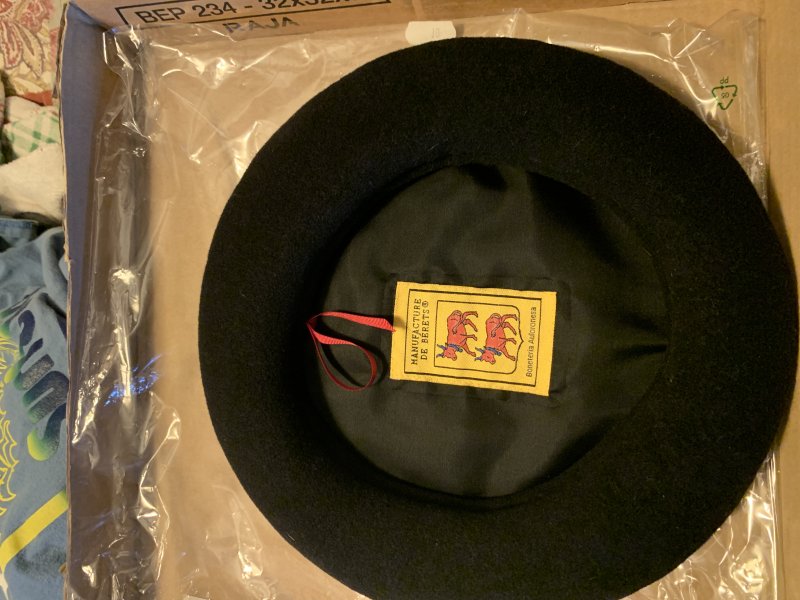
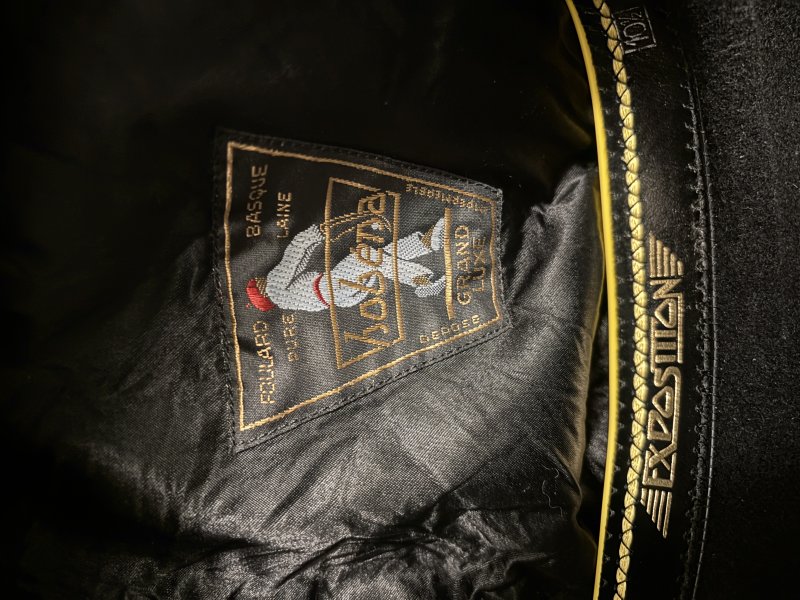
Mail call yesterday, this “exposition” beret with a fantastic tag inside. 10-1/2” plate diameter, 60 cm leather band. Not sure of the age, but the leather is in “like new” shape.

I just gave it the gentle wool detergent wash, shaping, and now it’s drying. I took the photo while the beret was still wet - so the tag colors don’t look as vibrant.

Soon to be in the air from Daan: a MdB Luxe in black. Very much looking forward to that one!
 

Attachments

  • IMG_6526.jpeg
    IMG_6526.jpeg
    2.9 MB · Views: 110

Daan

Vendor
Messages
971
Location
Wellington, Aotearoa
A fascinating find! A news article, including photos and business cards, about berets from 1929.

On 29 September 1929, François Malsant of the newspaper La Gironde, reported about the (then new) El Ramuntcho beret factory in Bordeaux.
BERET%20EL%20RAMUNTCHO1.JPG

"A few years ago, it would not have been considered good form to appear in town wearing a Basque beret. It was a purely local attribute that was tolerated, outside its country of origin, only by a few fanciful people. Then, athletes took it up and realized that this headgear, which holds well to the head and allows the hair to be kept in order, regardless of the violent movements of the body, was more pleasant and more practical than any other.”
“Some young women, in turn, noticed that the beret, whether blue, black, white or red, was more flattering to the face than the most charming "bibi", and gave them a very amusing little boyish look. They did not hesitate to adopt it, in some seaside resorts. Then, it was for long car rides, for tennis, for golf, that they used it.”
TENNIS%20PLAYER%20JEAN%20BOROTRA%20WITH%20BERET.JPG
Basque tennis player Jean Borotra
“One day, the Prince of Wales, while crossing from Brittain to Bayonne, had, it is said, his hat blown away by a gust of wind. There was a Basque hat shop nearby. He went in and, seeing nothing to his liking, chose a beret. Half an hour later, all the fashionable people of Biarritz were looting the bazaars and coming out wearing berets.
BERET%20DEAUVILLE.JPG
Women with berets in Deauville
The fashion was launched. It lasted. The Basque beret crossed borders. It is worn in England, the United States, Poland, South America, and Czechoslovakia.”
“The existing factories were no longer sufficient to ensure the necessary production. And, little by little, we saw industrialists dedicating themselves to manufacturing which found increasingly wide outlets.
A factory has recently opened in Bordeaux. It is located, along with large hosiery workshops that are part of the same organization, near the Xaintrailles barracks, a stone's throw from the main boulevards.
We went to visit it, thinking it would interest our readers by revealing the manufacturing processes of the French beret.
It is not, in fact, the large beret of the Spanish provinces that is being prepared here. It is a headdress of medium dimensions, more becoming than the small Landes vine, and less voluminous than the Guipuzcoa beret.”
Knitting loom
“Looms are responsible for the first operation: knitting the wool. This will produce a knitted clip of soft, short wool, made up of twenty-four quarters, which bears little resemblance to the beret as it will be displayed in the hatter's window. It is not closed and could quite easily be compared to a piece of Brie cheese. It is, moreover, much larger than it should be later, because, after various operations, it will shrink by about 25%.”
Fulling mill
“Here it is now going through the chain stitching machine , it is then closed. Then, it is the darning, which aims to fill the holes, repair the small manufacturing defects and shape the famous "tail", which will crown the headgear.”
“This is when the most curious work will take place: the fulling . Twenty kilos of moistened berets are piled into a sort of vat. A wooden hammer, driven by an electric motor, will pound them. A determined quantity of soap will activate this operation, after which the knitting, shrinking little by little, will become a beautiful tight felt. Rinsing will then proceed to eliminate all foreign matter.

The berets, removed from the vat, are then wrung out, then they are dyed.”
“The wool used, it is worth noting, is grey. It is only for the manufacture of white berets that a special wool is used, white from the very first operations.
El%20Ramuntcho%20(2).jpg

The dyeing, which is done in a kind of paddle boat, lasts, depending on the case, one hour to one and a half hours.”
“Each beret will now be stretched over wooden forms and placed in drying rooms where it will be treated with steam at 50 to 60°. For white berets, sulfur will have to be sent using the Clayton process.
When they have undergone this treatment, the berets will not be far from finished. However, they will still have to undergo two operations before they can be worn.
1755062118126.png

First, they will move on to scraping. Imagine a small millstone made of natural thistles mounted on a millstone that rotates at a set speed.
The beret is presented on its upper and lower sides, and thus takes on relief. All that remains is to pass it through the clippers, which will remove the excess down.”
El%20Ramuntcho%20a.jpg

“To obtain different sizes, it will be enough to stretch it before proceeding with the filling, that is to say to place a leather inside and to line the bottom with a silk which is generally of a bright color. The machines, driven by charming workers, have completed their role.
El%20Ramuntcho.jpg

The truck, the railway and the ship will begin theirs..."
 

jon_slider

New in Town
Messages
10
Received a UN Blue 16” Elosegui Txapeldun (without leather sweatband). I love the color, exactly what I had hoped for.


opa.JPG

My personal preference is to soak, smash, squeeze, and manipulate a new beret in Hot Tap Water, and then wear it until it dries in the shape I set it to. The photo is the day after that process. Sorry, no before hot soak pic..

The soak and dry result is perfect for my tastes. It is no longer floppy with wavy edges. Now it holds its shape reliably. It is now 13” in diameter, which is very much to my liking.
 
Last edited:

Edward

Bartender
Messages
26,271
Location
London, UK
I am a big fan of Tony Sylvester’s brand AWMS. He sells “short flight” berets in black and seasonal colour releases which I find are much easier to wear without drawing comments or funny looks. They work well in formal dress and casually.

His shop is here: https://awms.bigcartel.com/product/the-beret

This is taken from AWMS’s shop and is Tony himself.

These smaller berets - which to my eye have something of a 50s, beatnik look to them - certainly pass less noticed in the current world. Maybe a side effect of the popularity of docker caps / tiny beanies in recent times? (I don't wear the latter out myself, but I picked up two or three for wearing round the house in depths of Winter.

Interesting, though, when you get into berets how you find yourself wearing different berets differently. I have a couple of cotton Fear Naughts which I have badges on the front of, and I' tend to put those on with the badge centred and front. The ones with a leather sweatband, I find myself habitually putting the bow to the back of my head as it would be on any fedora. Then there are the Laulhere models with no sweatband and no badge; those I throw on any old angle and then pull them to the back / front / side as desired once in place. The latter are, I suspect, the most authentically worn in my case...
 

jon_slider

New in Town
Messages
10
All four of these Txapelas are from Elosegui, and have the same label, but different actual weight.

The top dimension is the size before I soak and mash in hot tap water. The bottom dimension is the shrunken size.


Screen Shot 2025-08-17 at 2.32.07 PM.png

Three of them came from Ron Greer and they weigh more than the one I just received from boinasytxapelas.com, mailed from Spain. (Im in USA)

Note the newest 16" Txapeldun, in Nato Blue, has the lowest weight, 6.6oz.. its more pleasant to wear than the heavier large Black one, 9.1oz, during the summer. I like the shrunken 13” size as it can still serve to block the sun when pulled forward, or to stop the wind from blowing against the back of my neck. Without being too floppy, because the hot soak tightens the knit, which helps it hold its shape better.

The 2 older 14.5" Txapeldun have been worn for over 5 years, and I wear a beret most days. I have worn the smallest one for over 10 years. The 3 older ones have all been hand washed, multiple times, but that fails to extract the deeply soaked in sweat and body oils.

So Im going to get them dry cleaned next. While I enjoy my nice clean new lightweight Nato Blue Txapeldun.
 
Last edited:

M. du Barrage

New in Town
Messages
4
@Daan Could you please tell me if there's difference in quality between a woolen beret by Le Beret Francais and an Elosegui Super Lujo? Which one is better quality/value?
 

jon_slider

New in Town
Messages
10
Hopefully Daan will add from his wealth of knowledge.

meanwhile, from looking at the online websites..
Le Beret Francais
they use a mismatched color for the cabillou and only have one diameter, 11"
Screen Shot 2025-08-23 at 2.33.19 PM.png


The Super Lujo starts at 11.5" and goes up to 14". The cabillou color matches.
Screen Shot 2025-08-23 at 2.42.48 PM.png
 

Daan

Vendor
Messages
971
Location
Wellington, Aotearoa
Hopefully Daan will add from his wealth of knowledge.

meanwhile, from looking at the online websites..

they use a mismatched color for the cabillou and only have one diameter, 11"
View attachment 724924

The Super Lujo starts at 11.5" and goes up to 14". The cabillou color matches.
View attachment 724926
True, the colour of the cabillou is different (on the top models by) Le Béret Français, but there are many more differences that are more significant.
* Boinas Elosegui uses Australian merino wool for their berets, while Le Béret Français uses French merino wool from Arles. Australian merino tends to be softer to the touch, whereas French merino fibers are stronger and also, French animal welfare regulations go a lot further than Australian, where mulesing is still common practice.
* All berets made by Boinas Elosegui, apart from the Basica and Fina models, are treated with Teflon for waterproofing. It is a much debated issue and you should do your own research on this; many strong voices against and for the adding of Teflon. Le Béret Français are of a good tight knit and although not 100% waterproof in a long shower, they have a good natural water resistance.
* The boina Super Lujo is a densily knitted beret with a long felting process, resulting in a stiffer, more solid beret, compared to the lighter models by Le Béret Français.

Quality and value is a difficult one to answer; so much comes down to personal preference of the individual wearer (weight, stiff vs floppy, tight or loose, etc). In my opinion, the Super Lujo models rank among the top, but I don't appreciate the added Teflon myself.
The Le Béret Français I appreciate for their comfort and ease to wear. Objectively, not the absolute top in quality, but very pleasant.
When looking for a top quality beret without Tefdlon added (and due to its manufacturing process waterproof), there is nothing that beats an Auloronesa by Manufacture de Bérets.
 

shopkin

One of the Regulars
Messages
196
Teflon is a type of PFAS (the dreaded "forever chemicals") and has environmental and health impacts. Wool can be impregnated with some additional natural lanolin wax to get almost the same amount of water proofing.. Cotton can be treated with extra cotton seed oil. But if you overdo them you'll get that waxed canvas look and feel that wouldn't be good in a beret

Even when water proofing is not needed, most fabrics are "finished" to make them smoother and wrinkle-resistant. The fabric finishers are the same type of PFAS chemicals but at a lower concentration.
 
Last edited:

M. du Barrage

New in Town
Messages
4
Thank you very much for all your help, experience and information! I already have two berets by Manufacture de Bérets (11 and 12 pouces). I want to add a 10 pouces/28cm beret. Prices of Manufacture de Berets are much higher, and some change can also be nice.

Is the main difference between the Elosegui Basica and Fina the lining? How does the classic beret by Le Beret Francais compare to the Fina?
 
Last edited:

Daan

Vendor
Messages
971
Location
Wellington, Aotearoa
Thank you very much for all your help, experience and information! I already have two berets by Manufacture de Bérets (11 and 12 pouces). I want to add a 10 pouces/28cm beret. Prices of Manufacture de Berets are much higher, and some change can also be nice.

Is the main difference between the Elosegui Basica and Fina the lining? How does the classic beret by Le Beret Francais compare to the Fina?
Absolutely, change is good at times and makes one appreciate preferences again.
Although I am pretty much hooked on my MdB/Auloronesa berets, I often enough go for a Le Béret Français Classique or a Spanish Clásica.
No, the difference between the boina (Elósegui) Básica and Fina is more than the lining and label - the Fina is a denser knit and is softer to the touch, slightly heavier per m2.
The LBF Classique is a different feel from the Spanish berets due to the French merino wool fibers versus Australian merino that's used by Boinas Elósegui. Again, much comes down to personal preference, but I prefer the LBF (and now the reinstated MBBB) berets for their feel and look, slightly rougher than the soft and floppier Basica and Fina models. Objectively, I would say both are of very similar quality.
Again personal, but I appreciate LBF's efforts to diminish their environmental impact as much as possible, being at the forefront of environmental and ethical manufacturing.
 

shopkin

One of the Regulars
Messages
196
Patagonia has been fighting the same PFAS dilemma. They have an article describing the progression, but the bottom line is that they can't get satisfactory waterproofing for extreme wear without some compromises. At least, not yet.
 

Daan

Vendor
Messages
971
Location
Wellington, Aotearoa
South Pacific Berets halts beret sales to US customers

President Donald Trump’s decision to revoke the long-standing “de minimis” exemption—previously allowing packages under $800 to enter the U.S. duty-free—is sending shockwaves through global commerce. Small businesses, such as South Pacific Berets, are bearing the brunt of this abrupt policy shift.
1756437575461.png

The new rules require tariffs to be paid on every imported item, calculated by country of origin. This means a U.S. customer ordering three berets—from Argentina, France, and Japan—now faces three separate tariffs ranging from 20% to 50%, plus a flat customs fee that may exceed the value of each beret. For small retailers, whose margins are already razor-thin, this complexity and cost are untenable.
1756437599476.png
1756437614399.png

Worse still, postal services around the world—including New Zealand, Australia, Japan, and over 20 other countries—have suspended shipments to the U.S. entirely (1, 2, 3). The reason? U.S. authorities have failed to provide clear mechanisms for how these tariffs are to be calculated or paid. Without a functioning system, foreign postal operators are left in limbo, unable to guarantee delivery or compliance.
This chaos disproportionately harms small businesses, which lack the infrastructure to navigate sudden regulatory overhauls. Unlike large corporations, they can’t absorb the costs or pivot supply chains overnight. Many are now forced to halt U.S. sales, losing access to one of the world’s largest consumer markets.
1756437644647.png
1756437657677.png


1756437841177.png
1756437851274.png

For the time being, no berets will be shipped to the US and [as it looks now], when resumed will go at a significant higher cost...
More on South Pacific Berets and the tariffs at RNZ and Business Insider.

Bartender Edit: A very small snip has been applied to this post to remove an element of political commentary. We are very aware that these controversial tariffs are impacting our membership significantly, as both customers and traders. We would, however, ask that everyone please remember the House Rules on political discussion and keep discussion of the tariffs issue purely informative, viz 'this is how the process worked for me as a buyer', or 'here is how we are changing our shipping policy in the present situation'. Thank-you.
 
Last edited by a moderator:

Edward

Bartender
Messages
26,271
Location
London, UK
These images are hoiked from Facebook - you can find them and more here:

https://www.facebook.com/photo?fbid=1322899209199434&set=pcb.1322899515866070

For those of us of a certain age in the UK, one of the first people we'd have seen sporting a beret in public might well have been Captain Sensible, one time bassist, latterly guitarist with punk rock legends The Damned, known for almost fifty years for his trademark red beret. Now his poodle Oki has a matching one...

1756467625523.png


Notably, Oki's beret is a two-piece affair. A dim memory suggests I once read this is a traditional method of construction in part of the beret world outside the Basque region.... Eastern Europe?

1756467657718.png


I'm inclined to find out where this came from and see if Bertie Dog will wear one - our little man has proven to enjoy his clothes very much in the Winter.

Below is Oki with the legendary Dave Vanian, the voice of the Damned for almost fifty years. Mr Vanian is seen here dressed down, as he does for the stage. Away from performing, he is more commonly seen dressed in perfect 1930s-style. Rarely seen without dark glasses in any environment, which has, naturally, played into the long running rumour he is an actual vampire. ;-)

1756467802844.png


Quite the young gentleman, Oki.
 

Babbo Philipe

A-List Customer
Messages
342
Location
San Pedro
All four of these Txapelas are from Elosegui, and have the same label, but different actual weight.

The top dimension is the size before I soak and mash in hot tap water. The bottom dimension is the shrunken size.


View attachment 723897
Three of them came from Ron Greer and they weigh more than the one I just received from boinasytxapelas.com, mailed from Spain. (Im in USA)

Note the newest 16" Txapeldun, in Nato Blue, has the lowest weight, 6.6oz.. its more pleasant to wear than the heavier large Black one, 9.1oz, during the summer. I like the shrunken 13” size as it can still serve to block the sun when pulled forward, or to stop the wind from blowing against the back of my neck. Without being too floppy, because the hot soak tightens the knit, which helps it hold its shape better.

The 2 older 14.5" Txapeldun have been worn for over 5 years, and I wear a beret most days. I have worn the smallest one for over 10 years. The 3 older ones have all been hand washed, multiple times, but that fails to extract the deeply soaked in sweat and body oils.

So Im going to get them dry cleaned next. While I enjoy my nice clean new lightweight Nato Blue Txapeldun.
i used to get my Elosegui wet but they have a tendancy to shrink unevely , but to Me they need to be shaped right-- now if i wet them, i have a small innertube i use to keep the shape as it dries, ,-- inside out-- my manufacture berets they dont shrink significantly, i try not to get them wet much any more , i have ruined a few berets, mostly Elosegui, the Manufacture de beret they are pretty good from the start, i have alot of originals from Manufacture very thick, i still have an original from Denis , still in the box brand new , with the Savon soap smell
 

Attachments

  • IMG_3976.JPG
    IMG_3976.JPG
    3.2 MB · Views: 75
  • IMG_3978.JPG
    IMG_3978.JPG
    3.3 MB · Views: 64
  • IMG_3977.JPG
    IMG_3977.JPG
    3.3 MB · Views: 60
  • IMG_3979.JPG
    IMG_3979.JPG
    2.9 MB · Views: 66
Last edited:

Daan

Vendor
Messages
971
Location
Wellington, Aotearoa
Amid escalating tariffs and trade barriers imposed by the Trump administration, American beret wearers have found themselves cut off from affordable access to authentic headwear. Now, an unusual act of generosity offers both relief and purpose. An American philanthropist (who wishes to remain anonymous), known to be a passionate collector of berets, has donated a significant portion of his collection to South Pacific Berets.
1757388859535.png
1757388869905.png

The collection consists entirely of brand-new berets, each fitted in a poly bag with silica desiccant. By arranging shipment from Oregon, USA, this initiative ensures customers face no tariffs, surcharges, or additional government fees—an intentional counter to the financial obstacles that have disrupted the flow of berets into the country.
1757389040544.png

In keeping with the spirit of the donor, the project goes beyond commerce. Thirty percent of all proceeds from these sales will be donated to Médecins Sans Frontières (Doctors Without Borders), the international humanitarian organization delivering critical medical aid in crisis zones worldwide.
1757389068677.png
1757389082606.png

The effort underscores both a resistance to restrictive trade measures and a commitment to global solidarity. For American beret enthusiasts, it represents a rare opportunity: access to authentic headwear, free from artificial costs, while simultaneously contributing to life-saving work abroad.
1757389126353.png
1757389141099.png

Over the next weeks (writing this September 9), the full collection will become available on this page. From a private collection means only one, occasionally two, of each model is available for sale.
 

Daan

Vendor
Messages
971
Location
Wellington, Aotearoa
The Rise of the Beret Industry in (La Rioja) Spain

The last beret factory in La Rioja was Boinas Roig of Santo Domingo de la Calzada.
1945 MARCA BOINAS ROIG BOPI - Trademark Registration 1945.JPG
Pradoluengo.jpg

Beret-making shifted from home-based craft to large-scale industry in the 19th century. In 1852, Esteban Hurtado de Mendoza acquired one of Spain’s first beret factories in Azcoitia, describing how women knitted berets at home for wages, while factory workers handled finishing. This industrialization freed Spain from costly French imports.
Technological advances soon multiplied production. Circular knitting machines allowed a worker to produce 20 berets a day, later soaring into the thousands with mechanized looms.
Advertisements from the La Rioja newspaper 1940 and 1927.png

Factories spread quickly: Antonio Elósegui’s in Tolosa (1858), La Encartada in Balmaseda (1892), and others in Olot, Alcoy, Vigo, Zaragoza, and beyond. By the 1930s, production reached astonishing levels—4,500 berets a day in Tolosa alone—with “Castilian,” “Basque,” and other locally branded berets marketed as cultural emblems. Between Ezcaray and Pradoluengo, output exceeded 4 million berets annually.
beret factory Coruna in Linares Rivas 50.jpg

The Riojan and Burgos highlands, once declining textile regions, found new life in beret-making. Workshops in Ezcaray and Pradoluengo flourished, supplying markets across Spain. By 1935, Pradoluengo hosted seven beret factories producing 1.5 million units a year, with exports abroad. The last, Boinas Mingo, closed in the early 2000s.
Founded in 1916 by Gregorio Roig, a Haro-born textile entrepreneur, Boinas Roig became La Rioja’s last beret factory. Roig came from a powerful merchant family with ties to banks, wineries, and retail textile trade. His factory thrived during the beret’s golden era.
Ezcaray 1934 Fabricas de boinas 1934 advertisements from Ezcaray beret factories.png
Elosegui 3.jpg

After Roig’s death in 1949, the factory passed to Pedro María Sáenz de Pipaón, who modernized production with American machinery and marketed primarily in Galicia and Castile. Though the factory survived longer than others in La Rioja, its final berets eventually carried the label “Made in Pradoluengo,” symbolizing the shift of production to Burgos.
Panal 20.png

For over a century, beret factories in La Rioja and Castile generated wealth and identity, turning a humble wool cap into an industrial icon. Today, only a few historic names like Elósegui remain, reminders of when millions of Spaniards proudly wore the boina.
La ultima boina riojana Roig.png
 

Forum statistics

Threads
114,480
Messages
3,175,370
Members
58,318
Latest member
Pikapen
Top